


Why Real Estate Won’t Be Sold Without Human Agents, Even in the AI Era
We’ve been to this movie before. Every few years, the real estate industry finds itself the target of a well-funded assault by tech outsiders that promises to disrupt what they see as their last and biggest opportunity. As each new technology emerges, headlines declare that disintermediation has finally come for real estate, and agents are told their days are numbered. First it was the Internet. Then Portals. Then iBuyers. Then Crypto. Now, Artificial Intelligence (AI) has taken up the mantle of disruption.
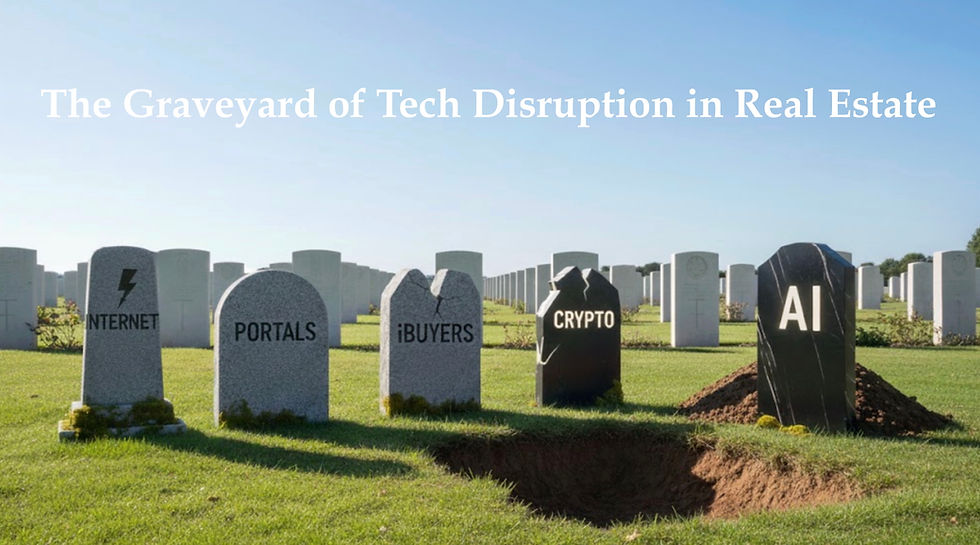
The latest narrative suggests that AI-powered valuations, synthetic guidance tools, and “Buy Now” buttons will finally replace human real estate professionals. But there’s a flaw in this thinking, and it comes down to a simple truth: homes are not commodities.
The Myth of Buying and Selling Real Estate Online
Things that can easily be bought online tend to fall into two categories. The first are true commodities, like 100 shares of Nvidia stocks or a barrel of oil, where one unit is identical to another. The second are functional copies, like iPhones or food processors that are mass-produced and that are interchangeable with one another.
Real estate fits neither category. Even when new home builders repeat the same floor plan in a subdivision, no two homes are truly alike. Construction quality, lot placement, natural light, street traffic, views, neighboring properties, and future development all create meaningful differences. They’re the nuances that determine value that go beyond what computer vision can see in photos, and what an algorithm can infer from statistics.
Homes Are Hand-Built and They Age Like People Do
Unlike products assembled by machines, most homes are built by hand. And once they’re lived in, they evolve in ways no dataset can fully capture:
Unique environmental conditions affect foundations, roofs, walls and drainage differently
Maintenance choices shape how a home deteriorates or maintains its value over time
Lifestyle factors mean that two identical homes can age very differently depending on how many people lived in it, whether they smoked, how often they cleaned it, etc.
Two homes built side by side in 1995 can feel worlds apart today. Buyers need help evaluating that reality. Sellers need guidance on how those differences affect pricing, positioning and expectations. Most people wouldn’t even consider buying a used car without a test drive. It’s hard to imagine them confidently purchasing a one-of-a-kind, hand-built home without having a trusted advisor take them inside and guide them in their evaluation of the home.
Technology Can’t Hold Your Hand
Make no mistake. Technology absolutely plays an important role in real estate. Data, analytics, and AI-driven tools make the market more transparent and efficient. But data alone isn’t the same as judgment. Both buyers and sellers benefit from local knowledge, the kind you only get from having boots on the ground. Which streets flood after heavy rain? Which neighborhoods are quietly improving? Which listings are priced to sell, and which are testing the market?
This is where experienced real estate professionals on both sides of the transaction continue to add irreplaceable value:
For Sellers:
Developing pricing strategies that go beyond automated estimates
Coordinating inspections, repairs, staging and marketing
Determining the best timing to put the home on the market and recognizing how other homes coming to the market will affect the sale
Holding open houses to expose the home to as many potential buyers as possible
Communicating with buyer’s agents, navigating timing and advising on whether to counter or accept an offer
Assisting sellers and holding hands through the close of escrow
For Buyers:
Showing homes with buyers and interpreting how the home fits with the buyer’s needs and how the home compares to other homes they have seen
Interpreting value beyond the list price
Spotting red flags and understanding how adverse issues affect value
Advising on offer strategy in competitive situations or knowing that additional listings are coming to the market
Negotiating terms that protect both finances and peace of mind
Assisting buyers and holding hands through the close of escrow
The Graveyard of Tech Disruption in Real Estate
The only groups that regularly buy homes sight-unseen are professional investors treating housing purely as an asset class. Most people aren’t doing that. They’re buying homes to live in, grow in, and build their lives around. That emotional and financial weight demands more than automation. It requires trust, communication and advocacy, especially when negotiations get tense or unexpected issues arise.
The graveyard of tech disruption in real estate is littered with well-funded startups and projects shuttered by publicly-traded companies that tried to turn real estate into a purely digital transaction. Many promised progress and transformation. All of them underestimated the complexity involved. Artificial Intelligence will continue to reshape real estate, but not by eliminating agents. Instead, AI will enhance the service provided by professionals who know how to combine technology with local knowledge, human insight, empathy and boots on the ground. As long as homes remain unique, personal, and deeply tied to place, human agents will continue to be at the center of it all.
f8 Blog Post: "Why Real Estate Won’t Be Sold Without Human Agents, Even in the AI Era"
(c) 2016-2026, f8 Real Estate Media, LLC. All Rights Reserved.


This is a truly valuable and well-explained post! I enjoyed how you shared the key information in such a clear and engaging way. The practical insights make the content even more useful and meaningful for readers. Great work, and I’m looking forward to your next post! we discovered this on openfuture
I really enjoyed reading this thoughtful and informative post! You’ve done a great job of making the topic simple, interesting, and easy to understand. The useful ideas and practical takeaways add real value. Thank you for sharing, and I can’t wait to read more from you! University GPA Calculator
Real estate may benefit from AI, but local knowledge, personal judgment, and trust still matter when people make major housing decisions. I especially liked the discussion about how every home has different conditions that technology cannot fully understand. After reading this perspective, I played the basketball legends game and found it genuinely fun and enjoyable for a relaxing break afterward.
connections hint today does more than test vocabulary because it asks players to identify the relationships hiding between different words. Grouping clues according to their deeper patterns makes the solving process especially engaging.
An ecommerce seo agency can optimize page templates so improvements to headings, metadata, schema, and internal linking can scale across large product catalogs.